


Any resemblance to actual events or persons is purely coincidental. Names and identifying details have been changed. The stakes, however, are very real.
In This Issue
The Deal: a Family Sells Control to a Fund for €200 million
The Catch: the Cash Shortfall and the Weaponisation of Insolvency Proceedings
The Emergency Relief that Stopped the Insolvency Proceedings in 14 Days
Lessons Learnt
A PE fund invested €200 million in a family consumer goods business on the basis that any shareholder loans needed in order to keep the group solvent would be subordinated to the fund’s preferred return. Seven years later, the family used those loans to file insolvency proceedings against the operating company.
1. The Deal : a family sells control to a fund for €200 million
In 2010, a PE fund takes a 40.17% minority stake in a family-owned European consumer goods business: personal care and household products, sold across European markets.
The majority is held by Marc, the eldest son, who is buying out his father, Henri, and his younger brother, Luca, using the PE capital. Henri and Luca exit the business at completion in March 2011.
The parties sign a Subscription and Shareholders’ Deed (“SSD”) under English law, with LCIA arbitration seated in Paris.
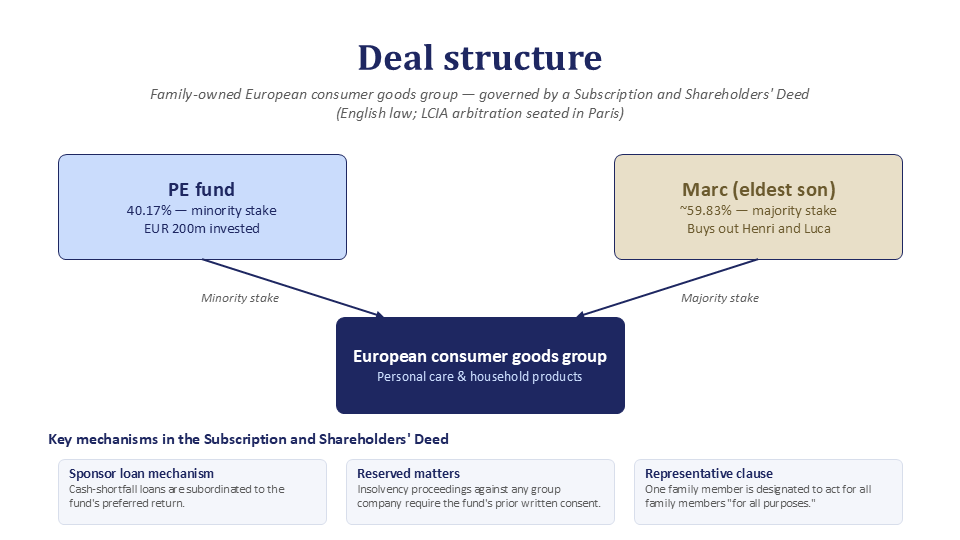
Three provisions of the SSD are relevant to this issue.
The sponsor loan mechanism: if the group faced a cash shortfall within fifteen months of closing, the family was required to provide or procure subordinated loans, i.e., loans which could not be repaid until the fund had received its preferred return. This protected the fund’s financial return. By forcing any rescue loans to sit behind the fund’s preferred return, it prevented the family from using their creditor position to extract money from the business ahead of the fund, whether intentionally or not.
The reserved matters list: each of the family members personally undertook to procure that insolvency proceedings against any group company would not be taken without the fund’s prior written consent. This gave the fund a veto over one of the most damaging steps a shareholder can take against a company. Insolvency proceedings, once filed, can trigger defaults, freeze operations, and cause irreversible reputational damage. Requiring the fund’s consent meant that the family could not use insolvency as a tactical weapon without the fund’s agreement.
The MP Representative clause: Marc was designated sole representative for all family members “for all purposes” under the SSD. Notification to him counted as notification to all of them. This simplified communications between a dispersed family and the fund by designating a single contact point. In practice, because of the drafting of that clause, it had a far broader legal effect: anything Marc did under the SSD was treated as having been done by the whole family, and notice given to Marc bound everyone.
2. The Catch: The Cash Shortfall and the Weaponisation of Insolvency Proceedings
In November 2011, a cash shortfall arose. Marc procured a bank loan of approximately €55 million for the group’s operating company, secured against assets belonging to companies owned by Henri and Luca.
In 2013, the bank redeemed those securities.
Henri and Luca’s companies became direct creditors of the operating company.
In March and April 2018, Henri and Luca’s companies filed insolvency proceedings against the operating company under applicable insolvency legislation. This had the effect of making the group unsaleable, thereby blocking the fund from exiting its investment at the valuation it was seeking, and preserving the family's control over the business.
The fund’s position: the 2011 bank loan was a Sponsor Loan under the SSD. The underlying debts could not be enforced before the fund had received its preferred return. The insolvency proceedings were a breach of the SSD.
Henri and Luca‘s position: they had not authorised Marc to procure a loan on their behalf, nor to offer their companies’ assets as security. The SSD’s sponsor loan mechanism had never been properly triggered. Their companies were recovering legitimate commercial debts.
3. The Emergency Relief Which Stopped the Insolvency Proceedings in 14 Days
The fund applied for emergency relief before the LCIA on 19 April 2018. An emergency arbitrator was appointed the following day.
The Emergency Award issued on 24 April 2018, ordering that Marc ask that the proceedings be adjourned pending determination of the arbitration. Fourteen days from petition to binding order. That result was only possible because the arbitration clause referred to an arbitral institution that offers an emergency arbitration mechanism. Without that, the insolvency proceedings would have continued to run.
Three months later, Marc caused the group’s manufacturing holdco to file its own insolvency proceedings against the operating company, seeking repayment of amounts alleged due under separate supply agreements.
The tribunal found in favour of the fund:
The 2011 bank loan was a Sponsor Loan.
The MP Representative clause had given Marc authority to act for all family members in implementing the SSD: whether Henri and Luca had individually been informed of the loan or had authorised the use of their assets as security was, as between them and the fund, irrelevant. As an implied term of the reserved matters provision, the family could not achieve through entities they controlled outside the group what they had undertaken not to do through group companies within it.
One point the fund lost: Marc’s counterclaim for a European commercial property. The SSD had specified that it would be transferred to the family at completion.
The obligation survived completion under the SSD’s terms. The tribunal ordered the fund to procure the transfer.
4. Lessons Learnt
The insolvency proceedings were a deliberate tactical move designed to make the group unsaleable and block the fund’s exit. No contract drafting prevents a party determined to breach it.
What the SSD could have done better is remove two sources of litigation risk.
The reserved matters clause relied on an implied term.
The family filed insolvency proceedings through companies they controlled outside the group, not through group companies directly.
The tribunal found, as an implied term of the reserved matters clause, that the family could not do through entities outside the group what they had agreed not to do through group companies within it.
The fund won but on a term which the clause did not expressly contain.
A reserved matters provision that must be extended by implication to cover affiliates outside the group creates a litigation risk that is much lower with an express provision. Had the clause expressly extended to affiliates and entities controlled by the majority outside the group, that costly part of the dispute could have been avoided.
The documentation failure increased the cost of the arbitration but did not determine its outcome.
As explained above, the sponsor loan activation steps were never recorded.
The tribunal certainly found in the fund’s favour but it had to reconstruct the relevant events from indirect evidence and correspondence, in order to so decide.
Proceedings that turn on reconstructing a seven-year-old sequence of events are more expensive and more uncertain than those with a clean contemporaneous record. Creating a written record during the life of the transaction may seem burdensome when one is focused on operational activities but you will thank yourself later for having done so if the relationship gets strained.
The arbitration clause was the one thing that worked as the parties had intended.
The emergency arbitrator stopped the proceedings fourteen days after the application. That required a clause that named an institution and incorporated its rules.
The Deal Catch is published monthly by Anima Dispute Resolution.
London · Paris
See you next month.